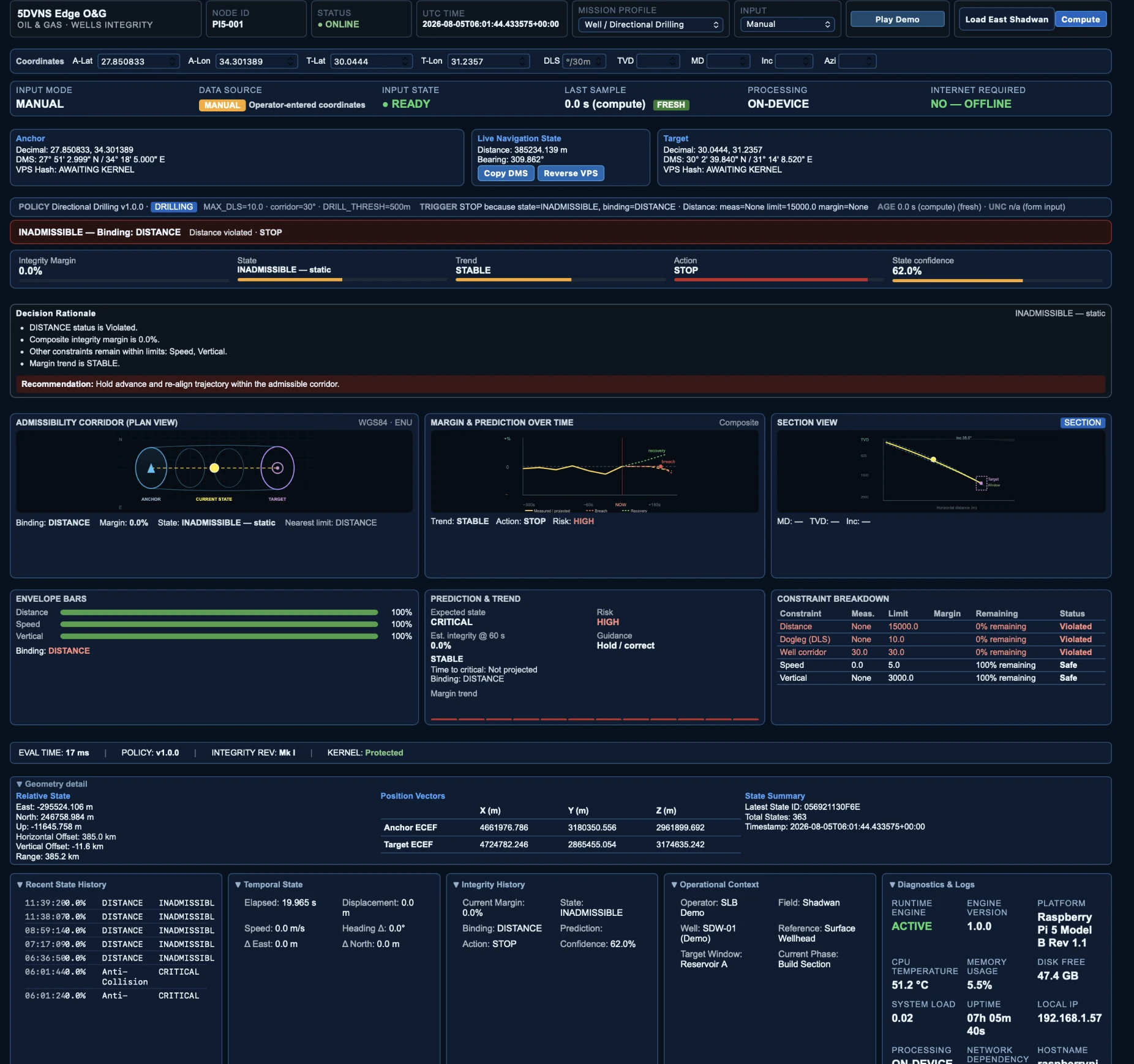
This interface is the finished 5DVNS Edge O&G prototype, configured as a low-compute supervisory layer for directional drilling. It demonstrates how drilling coordinates and trajectory parameters can be converted into a continuously evaluated volumetric operational state, rather than treated only as isolated position values.
The UI brings together the main elements required for drilling supervision in one deterministic view: anchor and target coordinates, live navigation state, admissibility status, integrity margin, binding constraint, trend, predicted state, confidence, recommended action, plan and section views, constraint breakdown, temporal history and system diagnostics. In the example shown, the system identifies DISTANCE as the binding constraint, classifies the state as INADMISSIBLE, reduces the integrity margin to 0%, and issues a STOP / Hold and correct recommendation while showing which other constraints remain within limits.
The significance for drilling operations is that 5DVNS is not presented here as a replacement for the drilling control system, MWD/LWD, survey tools or existing well-planning software. It acts as an independent supervisory integrity layer above them. The concept is to ingest available drilling-state information, relate it to the permitted operating geometry and constraints, determine whether the current state remains admissible, identify the limiting condition, and provide an explicit operational response before continued advancement.
This makes the prototype a meaningful proof of concept because it demonstrates the complete logic chain required for a drilling application:
- drilling inputs
- volumetric state representation
- constraint evaluation
- admissibility/integrity determination
- binding-constraint identification
- prediction
- operational recommendation
The prototype also demonstrates that this logic can run on-device on a Raspberry Pi 5, with the interface showing local processing and no internet required for core operation. That is important for drilling environments where deterministic edge processing, limited connectivity and independent supervision are operationally relevant.
The accompanying RC-model video provides the physical counterpart to the software demonstration. Together, the UI and low-compute model show that the 5DVNS concept is not limited to a theoretical representation: the same supervisory architecture can be executed on constrained hardware, evaluate an evolving physical state, and produce an actionable response.